Key Takeaways
- Fire and rescue crews use several torch formats, not one. Right-angle torches, helmet lights, head torches, handheld torches and pen torches each cover a different task.
- Intrinsically safe and ATEX-certified lighting is standard for hazardous areas. Where a flammable atmosphere is possible, it is certification rather than brightness that decides whether a torch is fit to carry.
- Brightness alone is a poor buying guide. Runtime, beam pattern, ingress protection, impact resistance and glove-friendly switching matter just as much.
- The role defines the torch. A breathing apparatus wearer, an incident commander and a paramedic need very different beams.
- USB-C rechargeable torches reduce cost and admin. Fewer disposable cells, faster turnaround between shifts, and one charging standard across the kit locker.
Introduction: What a Fire and Rescue Torch Is
A fire and rescue torch is portable lighting built for smoke, heat, water, impact and hazardous atmospheres. It is not a general-purpose flashlight with a tougher body. The differences are in the certification, the switch design, the beam pattern and the way it mounts to kit.
A high-street torch might fail in three ways on the fireground. The switch may be too small to work with structural gloves. The body may not survive a drop onto concrete from ladder height. The unit may not be certified for use where flammable vapour is present. A fire service torch is specified to avoid all three.
Note that "torch" has two meanings in fire and rescue. This article covers lighting. Cutting torches, such as oxygen-acetylene, propane-oxygen, exothermic and plasma arc systems, are separate equipment used for technical rescue cutting and are judged on cutting speed, fuel supply and control rather than beam output.
Types of Torches Used in Fire and Rescue
Different tasks call for different formats. Most services issue or approve several.
Handheld Fire Service Torches
Handheld torches give the most control over beam direction. They suit size-up, perimeter checks and general station work. Compact handheld models remain part of the standard rescue equipment range across UK suppliers. The trade-off is obvious: one hand is occupied.
Right-Angle Firefighter Torches
Right-angle torches clip to turnout gear and point the beam forward while both hands stay free. They are the classic fireground format. UK suppliers list ATEX right-angle torches specifically for firefighting in potentially explosive atmospheres, and at least one UK supplier markets an ATEX-approved right-angle cell torch explicitly for fire brigade and shipboard use.
Helmet Lights and Helmet-Mounted Torches
Helmet lights keep both hands free for tools, ladders and casualty handling. The beam follows the head, which helps in crawling searches. Weight matters here, since anything above roughly 150 g on the shell becomes noticeable over a long wear period.
Head Torches for Hands-Free Work
Head torches suit search teams, technical rescue and station tasks where a helmet is not worn. A good one offers flood for close work, spot for distance, and a rear red light for roadside and hillside visibility.
Pen Torches for Medical and Inspection Tasks
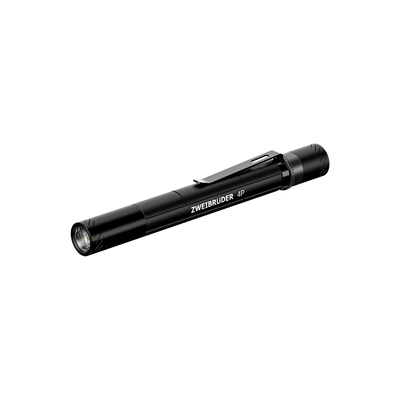
Pen torches are for pupil checks, wound inspection and looking into small voids. Output is deliberately low. Beam quality and colour rendering matter more than lumens.
Intrinsically Safe and ATEX Torches
Intrinsically safe torches are designed so they cannot produce a spark or hot surface capable of igniting a flammable atmosphere. On the fireground that typically covers the clip-on right-angle torches and the larger handlamps carried alongside breathing apparatus, available in both rechargeable and disposable-cell versions.
Common Features Firefighters Need in a Torch
Brightness and Beam Output
Most operational tasks sit between 300 and 1,000 lumens. Higher output helps outdoors and in large voids. Indoors, in smoke, very high output can reflect back and reduce useful vision.
Flood Beam vs Spot Beam
Flood spreads light across a wide area for close work and casualty care. Spot throws a narrow beam for distance, useful for search across fields, water or open ground. Auto-focusing torches that shift between the two without manual adjustment remove a fumbling step under pressure.
Battery Type and Rechargeability
Rechargeable lithium-ion suits high-tempo services. Primary cells suit low-use kit that must work after months in a locker. Many services run both.
Impact Resistance and Waterproofing
Look for IP66 or IP67 ingress protection and an IK07 or better impact rating. Aluminium bodies handle knocks better than most polymers.
Heat Resistance and Rugged Construction
Fireground lighting must tolerate radiant heat without lens distortion or seal failure. Sealed housings also keep out contaminants during decontamination.
Glove-Friendly Switches and Modes
Switches should be operable with a structural glove on, by feel alone. Fewer modes is usually better. A torch that cycles through six settings before reaching full output wastes seconds.
Night-Vision Preservation and Red-Light Mode
Red light preserves dark adaptation during map reading, casualty assessment and command work. A rear red marker light improves the wearer's own visibility on roadsides and hillsides.
Dual-Power and Backup Operation
Some torches accept both a rechargeable pack and disposable cells. That flexibility keeps a unit in service when charging is not possible.
See how each beam type behaves
Every beam is a trade-off between reach and spread. Select a beam type, then adjust the power level to see how the pattern and intensity change on a wall a few metres away.


Spot beam
An intense, focused beam with a soft halo around it. Reaches the furthest — this is the beam for searching and identifying at distance.
- Throw (reach) Long
- Spread (width) Narrow
Flood beam
A broad, even spread of light without harsh shadows. Ideal for lighting a whole room, doorway or scene at close range.
- Throw (reach) Short
- Spread (width) Wide
Reading beam
A uniform, shadow-free pool of light. Comfortable and glare-free for close-up tasks like maps, documents and equipment checks.
- Throw (reach) Short
- Spread (width) Medium
Spot + Flood beam
The combined beam: a focused hotspot inside a broad ring of flood light. Distance and peripheral awareness at the same time.
- Throw (reach) Long
- Spread (width) Medium
Power levels: Low 15 lm · Mid 600 lm · High 3,000 lm · Boost 4,000 lm.
Which Torch Is Best for Different Fire and Rescue Roles
Firefighters in Structural Incidents
Right-angle or helmet-mounted, intrinsically safe, flood-biased, with a runtime that covers a full deployment.
Search and Rescue Teams
Long-throw output for distance across open ground, a rear red light for team visibility, and IP66 or higher for weather exposure. A search and rescue torch with 300 m or more of beam distance is a reasonable benchmark.
Breathing Apparatus Wearers
Handlamps and right-angle torches attached to the BA set, certified for hazardous atmospheres.
Incident Commanders
A handheld with a red mode for tactical plans, plus a head torch for hands-free note-taking.
Paramedics and Medical Responders
Pen torch for assessment, plus a compact head torch for hands-free treatment.
Training and Station Use
Lower-cost rechargeable handhelds keep certified operational lighting in reserve for incidents.
Safety Standards and Certifications for Fire and Rescue Torches
ATEX Torches
ATEX certification means the equipment is approved for use in explosive atmospheres. Zone ratings define how often a flammable atmosphere is expected, with Zone 0 being the most demanding.
IECEx Certification
IECEx is the international equivalent scheme, and products are frequently certified to both. Torches built for this market often carry several approvals at once, with UKCA or CE marking alongside ATEX and IECEx. Check which schemes appear on the product itself, and confirm the zone rating matches the atmosphere you expect to work in.
Why Intrinsically Safe Lighting Matters
At incidents involving fuel spills, gas leaks or chemical release, an uncertified torch is an ignition risk. Certification is the only reliable evidence of suitability.
Compliance Considerations for UK Emergency Services
Since Brexit, UKCA marking sits alongside CE marking on much UK-supplied equipment. Procurement teams should confirm current marking, zone rating and the certificate reference before service issue.
How to Choose the Best Torch for Firefighters in the UK
Choosing by Operational Role
Start with the task, not the specification sheet. Search work needs throw. Interior work needs flood and hands-free mounting.
Choosing by Beam Pattern
If the user switches between near and far work constantly, an auto-focusing beam saves time. If the task is fixed, a dedicated flood or spot is simpler.
Choosing by Battery and Charging Method
USB-C is now the practical default. It matches vehicle charging, station charging and personal kit.
Choosing by Size and Carry Method
Consider pocket clips, helmet brackets, lanyard points and magnetic bases. A torch that cannot be secured will be dropped.
Choosing by Durability and Warranty
Ask for the drop-test height, IP rating and warranty length in writing. A long warranty signals confidence in build quality.
Choosing by Budget and Procurement Needs
Personal-issue torches typically fall between £40 and £150. Certified intrinsically safe models cost more. Judge on cost per year of service, not headline price.
Recommended Torch Features for Fire and Rescue Procurement
Minimum Lumen Range by Task
Pen torch 20 to 100 lumens. Interior work 300 to 600. Search and scene work 600 to 1,000 or more.
Required Runtime and Charging Options
Aim for at least four hours on a usable mid setting, plus USB-C charging and a spare-cell option where possible.
Mounting, Clips, and Helmet Compatibility
Confirm bracket compatibility with the helmets already in service before committing to an order.
Spare Batteries and Accessory Support
Check that cells, brackets and chargers remain available for the life of the product.
Warranty and Service Support
A seven-year warranty with UK support reduces whole-life cost and simplifies budget justification.
How Torches Are Used During Fireground and Rescue Operations
Interior Search in Smoke-Filled Environments
Smoke scatters light. A wide, lower-output flood angled low along the floor usually reveals more than a bright spot aimed ahead.
Vehicle Extrication and Technical Rescue
Close-range flood light on the working area, with hands free for cutting and spreading tools. Head and helmet lights dominate here.
Night Searches and Wide-Area Recovery
Long-throw beams for sweeping ground, rear red lights so team members stay visible to each other and to passing traffic.
Confined-Space and Hazardous-Area Work
Certified intrinsically safe lighting only. Compact bodies help in restricted access.
Scene Assessment and Perimeter Checks
Handheld torches for size-up, hazard identification and cordon walks.
Table: Comparison of Torch Types for Fire and Rescue
Comparison Criteria
| Torch type | Beam style | Mounting | Hazardous-area option | Main advantage |
|---|---|---|---|---|
| Right-angle | Flood | Clips to turnout gear | Yes, ATEX models common | Hands-free on the fireground |
| Helmet light | Flood or mixed | Helmet bracket | Yes | Beam follows head, both hands free |
| Head torch | Flood and spot | Headband | Varies by model | Hands-free without a helmet |
| Handheld | Spot or adjustable | Hand, clip, holster | Varies by model | Best beam control and reach |
| Pen torch | Narrow flood | Pocket clip | Usually not required | Medical assessment and inspection |
Best-Use Scenarios by Torch Type
Right-angle for BA entry. Helmet light for interior search. Head torch for technical rescue. Handheld for size-up and search. Pen torch for patient assessment.
Table: Key Specifications to Compare When Buying a Firefighter Torch
Brightness and Runtime Comparison
| Task | Suggested lumens | Suggested beam distance | Minimum runtime |
|---|---|---|---|
| Medical assessment | 20 to 100 | Under 20 m | 2 hours |
| Interior firefighting | 300 to 600 | 50 to 100 m | 4 hours |
| Technical rescue | 400 to 800 | 100 m | 4 hours |
| Wide-area search | 600 to 1,000+ | 300 m or more | 6 hours |
Durability and Ingress Protection Comparison
| Factor | Minimum to look for | Preferred |
|---|---|---|
| Ingress protection | IP54 | IP66 or IP67 |
| Impact rating | IK05 | IK07 or higher |
| Body material | Reinforced polymer | Anodised aluminium |
| Drop test | 1 m | 2 m or more |
Certification and Compliance Comparison
| Certification | What it covers | When it is needed |
|---|---|---|
| UKCA / CE | General product conformity | All service-issue equipment |
| ATEX | Explosive atmospheres, by zone | Fuel, gas and chemical incidents |
| IECEx | International explosive-atmosphere scheme | Multi-agency and shipboard work |
| IP / IK ratings | Water, dust and impact resistance | All operational lighting |
Why Rechargeable USB-C Torches Are Increasingly Popular in Fire and Rescue
USB-C Charging Benefits
One cable charges the torch, the radio accessory and the phone. Vehicles, stations and homes all have USB-C. That removes the need to hold proprietary chargers.
Reduced Maintenance and Logistics
Fewer disposable cells means lower consumable spend and less disposal admin over a multi-year cycle.
Suitability for Repeated Frontline Use
A torch that recharges in the appliance between calls is ready for the next job. That is the practical argument for rechargeable lighting in a busy service.
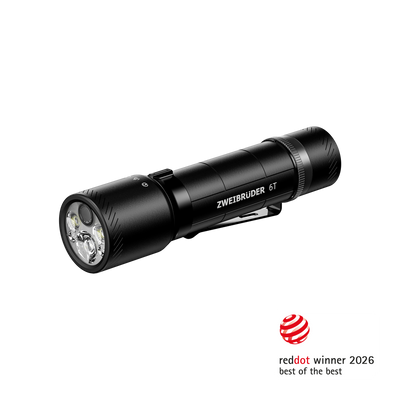
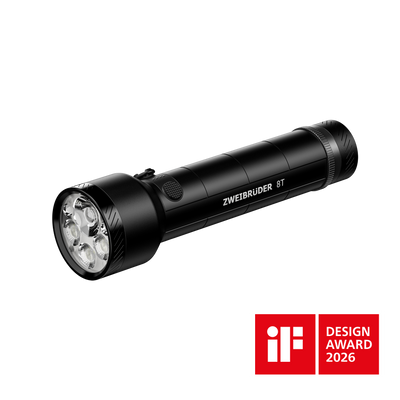
Zweibrüder Torch Range for Emergency Services
Zweibrüder produces portable lighting built around operational use rather than consumer specification sheets. Note that the models below are not ATEX or IECEx certified: where a hazardous atmosphere is possible, an intrinsically safe torch remains a separate requirement.
Coming Soon: the ZB19T
The ZB19T is the next addition to the professional handheld range, debuting at the Emergency Services Show in September with UK stock expected from October/November 2026. Full specifications will be published at launch.
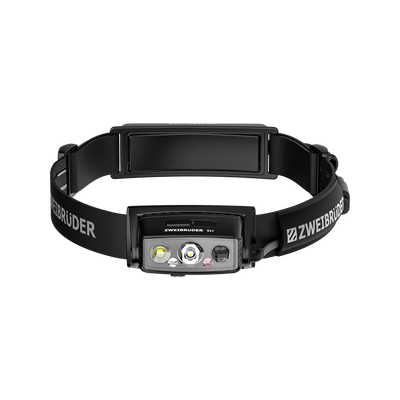
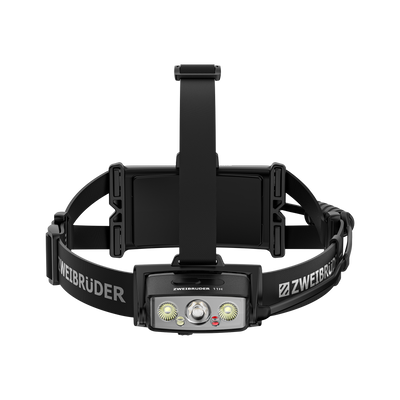
ZB Head Torches for Hands-Free Operations
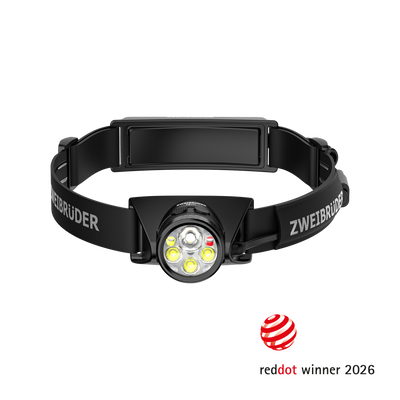
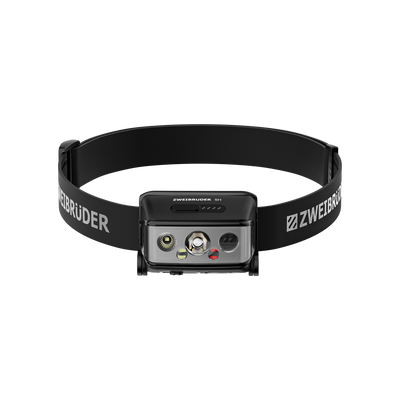
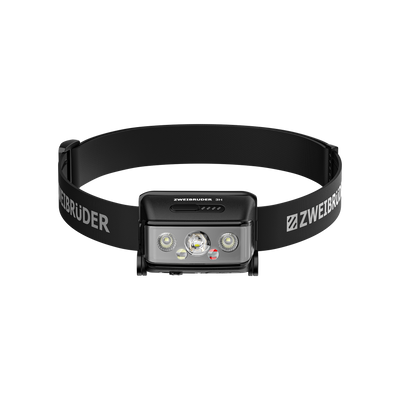
The ZB5H delivers 1,000 lumens and a 200-metre beam at 124g, with auto-focus, a red mode and dual power (USB-C plus 3xAAA) as a fallback on extended incidents. The ZB7H offers 1,200 lumens and 240 metres at 233g for larger working areas. The ZB9H covers search and size-up at 2,000 lumens and 260 metres, with auto-focus and a rear red safety light; it was named Best Headlamp by BILD. All three are IP67 sealed, USB-C rechargeable and helmet-compatible.
Choosing Between Them
Match output to the working distance rather than the headline figure: the ZB5H for close casualty and compartment work, the ZB7H for general fireground tasks, and the ZB9H where beam distance matters most. Our guide on how many lumens you need explains the bands in plain English.
USB-C Rechargeability and 7-Year Warranty
The range uses USB-C charging and carries a seven-year warranty, which supports procurement cases built on whole-life cost rather than purchase price.
Four lens technologies, one torch head
Each lens technology bundles one or more of the beam types above into a single head — from one fixed cone (MF) up to four switchable light functions (QF).


QF — Quattro Functional optic
Quattro Functional optic — four switchable light functions in one head. Maximum flexibility in any situation.
TF — Triplex Functional optic
Triplex Functional optic — a spot beam for range, a flood beam for broad coverage, plus an integrated red light that preserves night vision.
DF — Dual Functional optic
Dual Functional optic — switches between a spot beam for maximum range and a broad, glare-free flood for near-range work.
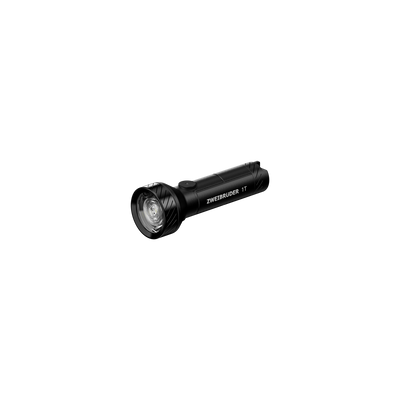
MF — Mono Functional optic
Mono Functional optic — a single fixed, balanced light cone for consistent illumination.
- Single fixed beam
Models: ZB1T
How to Maintain a Fire and Rescue Torch
Pre-Shift Checks
Test output, check charge level, inspect the lens for cracks and confirm the mounting is secure.
Cleaning After Incident Use
Wipe with a damp cloth and mild detergent. Avoid solvents on lenses and seals. Dry fully before storage.
Battery Care and Charging Discipline
Avoid storing lithium cells fully flat. Charge at room temperature. Replace cells that no longer hold a usable charge.
Storage and Readiness Checks
Store on charge where the manufacturer permits it, and record a monthly function check as part of the equipment schedule.
FAQs About Torches Used by Fire and Rescue
What Torch Do Firefighters Usually Carry?
Most carry a right-angle torch clipped to turnout gear or a helmet-mounted light, often with an intrinsically safe rating. Handlamps are also common where a larger, longer-running light is wanted, and anything taken into a potentially flammable atmosphere needs the appropriate certification.
Are Head Torches Allowed for Fire and Rescue Use?
Yes, for many tasks. Head torches are widely used in technical rescue, search work and station duties. For hazardous atmospheres, the torch must carry the correct certification.
What Is the Difference Between ATEX and Intrinsically Safe Torches?
Intrinsically safe describes the design principle: the torch cannot release enough energy to ignite a flammable atmosphere. ATEX is the certification scheme that verifies the design meets that standard. In practice, an ATEX-certified torch is intrinsically safe and has the paperwork to prove it.
What Lumen Output Is Best for Firefighters?
Between 300 and 600 lumens suits most interior work. Search and scene tasks benefit from 600 to 1,000 or more. Beam pattern and runtime matter as much as the lumen figure.
What Is the Best Torch for Firefighters in the UK?
There is no single answer, because the role decides. Look for the right beam pattern for the task, IP66 or better, glove-friendly switching, USB-C charging, a long warranty and, where hazardous atmospheres are possible, ATEX or IECEx certification.
Next Steps
Choosing a fire service torch comes down to matching beam pattern, runtime and certification to the actual task. Compare the specifications against your role, confirm the certification, and check the warranty before you commit.
To see the full range of head torches, handheld torches and pen torches built for emergency services professionals, including USB-C rechargeable models backed by a seven-year warranty, visit https://zweibruder.co.uk/.